


THE
EWING YOUNG TRAIL
by Kenneth
Munford & Charlotte L. Wirfs
(Originally published in the Horner Museum Tour Guide Series, 1981)
EWING YOUNG, a six-foot two-inch Tennessean, left tracks in various parts of
the west. As a trapper and trader, he traveled the Santa Fe Trail,
roamed southern California and the Sacramento Valley, and finally
came to Oregon. For an account of his adventurous life and the
lasting effect of his death, one should read Ewing Young: Master
Trapper by Kenneth L. Holmes, published by Binfords & Mort in Portland in 1967. In chapters 7 and 8, Holmes tells how Young and his
drovers herded 154 horses and mules north from California in
1834 and 630 cattle in 1837. The route they followed on these
drives is what we are calling the Ewing Young Trail for the purposes
of this tour.
Once the herds reached the Willamette Valley, Holmes says, "they
traveled on the western side ... skirting the coastal mountains,"
but does not go into further detail (p. 105). We know Young did
not
have to blaze a new trail. The way he came had served as a pack
trail
for trappers and traders for many years. It has had several names:
the Hudson's Bay Company pack trail, the Old California Trail,
and the Applegate Trail west of the Cascades.
As early as 1818 and 1820 trappers had explored southern Oregon. In 1827 Peter
Skene Ogden, in charge of a fur brigade in the Rogue River Valley,
gave Joseph Gervais, one of his French-Canadian employees, the
task of opening a trail north to the Willamette Valley and Fort
Vancouver. Gervais thereby became the first known white man to
travel what we here call the Ewing Young Trail. Subsequently,
Alexander McLeod, Michel LaFramboise, John Work, and other HBC
brigade leaders used the trail on expeditions in search of pelts
of the beaver and other fur-bearing animals.
From the Sacramento Valley, northern California,
and southern Oregon, the pack trails followed - with many variations - the
route used later by wagon roads, the Oregon & California Railroad, and highways U. S. 99 and I-5. Young's route we assume
to have been through the Rogue River Valley passing future sites
of Ashland, Medford, and Grants Pass and through the Umpqua Valley
passing present Roseburg, Sutherlin, and Oakland.
From the Yoncalla-Drain-Anlauf
area of northern Douglas County, Young's drovers in 1834 might
have taken either of two routes
into the Willamette Valley. That is, they could have followed
the HBC pack trail that went north from Anlauf through present
Lorane, Crow, Veneta, and Elmira. Or they could have taken
the route northeast over the divide between the Umpqua and the
Coast
Fork of the Willamette that is now used by railroad and highways
through Cottage Grove and Creswell to Eugene. Each of these
routes had been used earlier that year by HBC brigades, the one
from
Anlauf to Eugene apparently for the first time.
Brigade leader John Work came south into the
Umpqua in May 1834. He kept a diary (reprinted in the Oregon
Historical Quarterly, Sept. 1923) which gives a good description
of the pack trail used at that time. Work traveled by water from
Fort Vancouver to Sauvie Island. Even though he had a small brigade,
he required about fifty horses or mules. He obtained the pack
animals he needed near present Scappoose. His caravan crossed
the Tualatin Mountains and the Tualatin Plains and came south
through the Willamette Valley along the western side and left
the valley by way of Coyote Creek, Crow, and Lorane on his way
to the Umpqua Valley.
On his return trip, Work took a new route,
which apparently had not been used before but which immigrants
on the Applegate Trail used twelve years later and which since
that time has become the principal artery of transportation.
Work learned from Indian Charles that prospects were good for
trapping beaver on what we now call the Middle Fork of the Willamette
River. He hired Charles to guide him on June 21, 1834, through
Creswell, Saginaw, and Goshen area to the forks of the Willamette
near present Springfield. Work wrote in his diary: "Road across the mountains rugged & lies through thick woods."
Another HBC brigade was in the area in the
late summer of 1834, this one led by Michel LaFramboise, sometimes
called "Captain of the California Trail." LaFramboise came upon Young's party in the Roseburg area. Finding one of Young's
companions, Hall J. Kelley, very ill, LaFramboise nursed him
a bit and took him back to Fort Vancouver. This brigade would
have probably followed the established trail from Anlauf through
Lorane and Crow into the Willamette Valley.
Young's drovers therefore had a choice of
two routes. They may have followed Work's fainter trail made
in June or LaFramboise's trail made a few days before. In any
event, they would have stayed on the west side of the Willamette
and reached the present site of Monroe in southern Benton County.
The trail then took them northwest to Bellfountain, skirting
the flat, poorly drained area, and reaching the Marys River as
the next barrier to be crossed.
AN ALTERNATE ROUTE
John E. Smith, an Oregonian who had graduated
from Oregon Agricultural College early in the century and who
had been a professor of geology in other parts of the country,
returned in retirement to Corvallis. He spent a good deal of
time in the 1940s investigating the route of the old pack trail.
At that time he referred to it as the "Applegate Trail" because he was a member of a committee getting ready for the centenia1 of the
opening of the southern road into the Willamette Valley. To commemorate
the arrival of the first immigrants on that route, monuments
and arrow-shaped markers were set up with appropriate ceremonies
in 1946 and 1947 at a number of "strategic
points" by the Oregon Council, American Pioneer Trail Association. Some of the "Applegate Trail 1846" markers were erected along
the old pack trail, others at places where immigrants coming
into the valley from the south were known to have passed. Samples
of these markers can still be seen at Monroe, Philomath, and
Albany. Others have disappeared. At Lewisburg vandals took the
marker but left the concrete post.
In one of the several publications Mr. Smith
wrote, he says that where the pack trail crossed the Marys River
depended on the season of the year. In periods of low water the
crossing could be made between Corvallis and Philomath. The trail
then passed "below the present Catholic cemetery" in Corvallis and went north to Lewisburg
and Adair Village. Smith says, "The diagonal road of today from Airlie to Adair Village is little more than the
old trail straightened up a bit."
Smith goes on to say, "An
alternate route used during river flood time [was] by way of
Philomath and beyond two miles or more where two or three smaller
streams could be crossed easier than the larger one." This alternate route led north through Wren, Kings Valley, and Pedee to join
the main trail along the Luckiamute.
After fording La Creole (Rickreall) Creek
at present Dallas, the pack trail easily crossed rolling plains
and flat prairies to the Yamhill River. The rocky ledge that
made falls on the Yamhill also provided firm footing for horses
and cattle crossing the river.
Skirting or crossing western spurs of the
Red Hills of Dundee, the pack trail wound its way northward into
the upper Chehalem Valley and along the eastern bank of a vast
beaver-dammed swamp called Wapato Lake. It went on northeastward
across the Tualatin Plains to go over the Tualatin Mountains
on the Logie Trail or one of the other passes. The packers left
their horses on the western (Multnomah) channel on the lower
Willamette and took to canoes and batteaux for the return to
Fort Vancouver.
A HEAVEN FOR HORSES
After entering the Willamette Valley, Ewing
Young's herd of horses and mules would in general have followed
the old pack trail or the alternate route north from the Marys
River and gone on across the Luckiamute, La Creole, and Yamhill
streams. Eight miles north of the falls of the Yamhill, in the
upper Chehalem Valley, they found what Holmes calls a "veritable horse heaven." Here on a lush prairie dotted with shady oaks he turned the trail weary horses
and mules out to pasture. Here he decided to make his home.
Fifteen men had accompanied Young and the
154 horses and mules from California. Best known among them was
Hall Jackson Kelley, a romantic, erratic would-be colonizer who
spent much of his life in an evangelical attempt to interest
the people of the United States in obtaining the Oregon Country
and
settling it as an American territory. Although Kelley
claimed he had an "iron
constitution," he became ill along the way and, as mentioned before, received succor from Michel
LaFramboise, who took him through the Willamette Valley ahead
of the horse herd. At Fort Vancouver, Dr. McLoughlin gave Kelley
a cool reception but did provide some medical care and winter
quarters - outside the fort. In the spring after Kelley had recovered
from his malarial attack, the HBC chief factor arranged transportation
for him to Hawaii. Kelley arrived back in Boston in the spring
of 1836 and resumed his customary agitation for the settlement
of Oregon by Americans.
Also among Young's drovers were
- Lawrence Carmichael, who later became
a partner in Young's thwarted attempt to erect a whiskey-making
still.
- Elisha Ezekiel, who signed the petition against the still.
- Webley Hauxhurst, who
also protested against the still. He built a grist mill and
became one of the first trustees
of Willamette
University.
- Joseph Gale, who settled on Gales Creek near
Forest Grove.
- John Howard and William McCarty, who served
as officers in early attempts to form a local government.
- George
Winslow (Anderson), a black, who also joined the protest
against the still.
TROUBLED TIMES
When Young arrived in Oregon he found himself
and his party under a cloud of suspicion. Governor Figueroa of
California had written Dr. McLoughlin at Fort Vancouver that
the horses driven north by Young had been stolen. By the time
Young arrived in the Chehalem Valley, McLoughlin had banned all
trade with him both by HBC posts and by the French Prairie settlers.
Branded as a horse thief and denied the customary hospitality
of Fort Vancouver, Young became angry. He confronted the famous
chief factor (Holmes, p. 108). Each of these self-willed giants
was adamant. Young insisted that the horses he had purchased
in California had not been stolen. McLoughlin denied Young the
privilege of obtaining supplies. Young went back to the Chehalem
and prepared with American ingenuity and long experience on the
frontier to develop his own, self-sustaining ranch.
Having lived in the Mexican territory that
is now southwest United States, Young was familiar with the Mexican
system of huge land grants to army veterans and other favored
individuals, including foreigners. The grants in California frequently
amounted to 40,000 acres or more. In absence of any government
to make him a similar land grant, Young took it upon himself
to announce that he had taken responsibility for a 50-square-mile,
32,000 acre rancho in the Chehalem Valley. He built his cabin
and ranch headquarters in the upper valley and began to develop
the water power on lower Chehalem
Creek - south of present Newberg - for a grist mill and sawmill - and
for a proposed whiskey distillery.
Incidentally, a foreigner who later obtained
one of the best known Mexican land grants paid Ewing Young a
visit. According to Holmes (p. 141), "In the fall of 1838, John
Augustus Sutter, 'a Swiss gentleman,' visited the Willamette
community. He planned to go to California, return with a herd
of cattle, and settle near Young. His long-range plan was to
encourage settlers to come to Oregon from Switzerland." Sutter
went on to California but did not return. He obtained a Mexican
land grant of 48,839 acres on the American River and started
Sacramento. One of his employees, John Marshall, found gold at
one of Sutter's sawmills in 1848 and forever changed the course
of western history.
Twice, in 1832 and 1834, a New England merchant,
Nathaniel Wyeth, had attempted unsuccessfully to establish an
American trading post on the Columbia in competition with HBC.
When he returned to Massachusetts, he left Courtney Walker to
dispose of the goods and equipment left at his ill-fated trading
post on Sauvie Island. Among the equipment abandoned was a large
iron caldron. Young obtained this kettle from Walker and packed
it over the Tualatin Mountains to the lower Chehalem Valley.
As a youth growing up in the mountains of eastern Tennessee,
Young had become acquainted with methods of distilling alcohol
from sour mash. With the help of Lawrence Carmichael, he started
building a distillery to make whiskey to sell to the local residents
and Indians.
This action threatening the sobriety of the
Oregon community raised a furor. The five missionaries who had
come west with Wyeth had organized a temperance
society. Some of Young's men and a number of settlers, including
Joseph Gervais, Solomon Smith, and Etienne Lucier, had joined.
They wrote a protest to Young and Carmichael. HBC also protested.
Fur traders in the west had at times used alcohol as a medium
of exchange but by this time HBC has found whiskey in Indians
counter-productive and had banned its use in trade. One of Young's
purposes, however, in setting up a still was to disrupt the serenity
of the HBC monopoly. He paid no attention to protests from Fort
Vancouver.
This was in a period when the U. S. government
showed very little interest in Oregon. Senator Benton of Missouri,
always a staunch supporter of westward expansion, described the
attitude of the country toward Oregon as "tranquil." President Jackson, however, became mildly interested in the far west. He knew
that a young Navy lieutenant, William A. Slacum, would be on
the west coast of Mexico on other business and had Secretary
of State John Forsyth send Slacum to the Columbia to have a look
at the area. Slacum arrived in the midst of the excitement over
Ewing Young's still. He noted "laudable efforts in arresting this destructive element, the white man's poison,
the Indian's certain death."
The laudable effort which Slacum supported
was an alternative for Young's energy and enterprise: a cattle
drive from California that would bring much-needed draft animals,
milk, and beef to the settlements. This was a project in which
all factions could participate. The missionaries, the French-Canadian
settlers, HBC officers, and Slacum himself all contributed to
a fund to be used for buying cattle. Slacum took the drovers
- Young, Carmichael, P. L. Edwards, Hauxhurst, Calvin Tibbits,
George Gay, William
J. Bailey, and others, eleven in all - to San Francisco bay on
his chartered vessel. They arrived back in the Willamette Valley
in October 1837 with 630 lean Spanish cattle, mostly heifers.
They presumably followed much the same route used by the horse
drive three years before.
This act on Young's part brought him into
the good graces of all concerned. He settled down to develop
his rancho, said to be the farthest west farmstead owned by an
American at that time. Instead of a still he built a sawmill
and grist mill on the lower Chehalem. In a few years he became
the most prosperous settler in the area with his herds, farm
lands and mills.
AN END AND A BEGINNING
In his final illness in the winter of 1840-41,
Young was attended by Sidney Smith, a 31-year-old New Yorker
who had come west with the Peoria Party. Smith had some training
in medicine and carried with him a small chest of medicines.
William "Doc" Bailey, who had been on the cattle drive, had some
medical knowledge. Prescriptions of neither could save the ailing
Young. He died in early February 1841, aged about 47. To forestall
rumors that foul play might have been involved, Smith and Bailey
performed an autopsy
and reported that they had found a "sack of water ... in his brain"
and "that his stomach was destroyed by
acid he had been accustomed to take for his indigestion."
Young left no known heirs and no last will
and testament. At his funeral, members of the community agreed
that they needed a system of justice to administer his estate.
Instead of rushing in and plundering his property, the settlers
believed in law and order. In absence of any established legal
system governing the region they began to develop their own government.
At subsequent meetings a probate judge, a clerk, and three constables
were chosen. From this first step in self-government they moved
onward and two years later formed the Provisional Government
to administer all of the Oregon Country not within the jurisdiction
of the Hudson's Bay Company. Ewing Young's death, therefore,
had a greater impact on the future than did
his many activities during his lifetime.
Sidney Smith was allowed to buy much of Young's
property and stock. Other parts were sold at what were deemed
reasonable prices. The funds from the probate were used to build
the first jail at Oregon City - but it burned down a few days after
its construction! A young man from Taos calling himself Joaquin
Young showed up later and in 1854 convinced the Supreme Court
of the Oregon Territory that he was a son and heir of Ewing Young.
The Court awarded him $4,994.64 as a judgment. In the meantime,
Sidney Smith had gone off to the gold fields and returned with
$3,000. He operated a store at Lafayette from 1852 to 1862 and
died in 1880 at age 71.
ARTIFACTS ON THE EWING YOUNG TRAIL TODAY
THE HUDSON'S BAY COMPANY'S Old California
Trail coming north from the Umpqua passed through three drainage
systems: The Umpqua that has its outlet to the ocean at Reedsport,
the Siuslaw that runs into the ocean at Florence, and the Willamette
Valley. After the trail was designated as a Territorial Road,
mail was carried over it between Corvallis and Oakland, Oregon.
A stage coach service was established to southern Oregon. When
the first telegraph line with transcontinental connection came
north from the Sacramento Valley, it used this route. On March
8, 1864, the mayors of Portland, Maine, and Portland, Oregon,
exchanged greetings to publicize coast-to-coast service. Thirteen
months later the singing wires brought news of President Lincoln's
assassination.
Lorane on the upper Siuslaw dates from the
1880s and preserves a church built in that era. Much earlier,
in 1853, Darius B. Cartwright, a native of New York state, built
a hotel three miles south of Lorane as a stopping place for the
stage line. It had a telegraph station and post office. Cartwright's
daughter Katie and her husband William Russell operated what
they called the Mountain House for years. The fine old two-story
building with walls of hand-split cedar was considered one of
Lane County's most historic houses. It remained standing until
destroyed in recent years. The Eugene chapter of the Daughters
of the American Revolution placed a marker at the site.
Andy Crow, a relative of the William L. Crow
who started Lorane, has a community on upper Coyote Creek named
for him. To reflect its location on the historic trail the school
there is called the Crow-Applegate.
Coyote Creek now empties into Fern Ridge Reservoir.
If the pack trail followed Coyote Creek it would have crossed
the area now flooded by the Fern Ridge Dam. Nearby Veneta, founded
in 1913 by E. E. Hunter and named for his daughter, now has a
population of about 2,500. Elmira, originally called Duckworth,
is a bit older. It started as a smith operated by Byron Ellmaker.
At Franklin-Smithfield the DAR have also installed
a marker for this 1853 settlement on the Territorial Highway.
One of the roads between Franklin and Cheshire is still called
the Applegate Trail. From Cheshire to Monroe - much straighter
than in pack-trail days - the old route is still called Territorial
Road.
An early wagon road from Skinner's Eugene
City, paralleling present 99W, crossed the Long Tom River and
joined the pack trail at Monroe. The settlement here started
with a sawmill about 1850 and a store and post office at nearby
Starrs Point in 1852. The name was changed to Monroe in 1874.
Reminders of the railroad that once connected Corvallis with
Eugene are still visible in the Monroe vicinity. In pioneer times,
the Long Tom was a meandering swamp. Half a century ago a deep,
straight channel was dug. The Fern Ridge Dam built forty years
ago now regulates the flow of water, thereby bringing under control
this once flood-prone river. Solidly emplaced in masonry, one
of the arrow-shaped "Applegate Trail 1846" markers stands in the Monroe school yard.
Through Bellfountain (originally called Dusty),
John Smith says the trail ran between the present church and
store and from there somewhat followed the Bellfountain Road
to the Marys River. The house now used as headquarters for the
Finley Wildlife Reservation was on this route.
Marysville (Corvallis) got its start when
Joseph C. Avery staked a Provisional land claim at the mouth
of the Marys River in October 1845. With William Dixon on an
adjacent claim, Avery laid out the town. Avery became the first
merchant and postmaster and helped start Corvallis College in
1858. With state assistance, this college has developed into
Oregon State University. A river port in steamboat days, Corvallis
was also a minor railroad center at the crossing of one rail
line between Portland and Eugene and another from Yaquina Bay
to the Cascade Mountains.
The old pack trail ran close to the site of
Philomath, but travel on it had long ceased before the town was
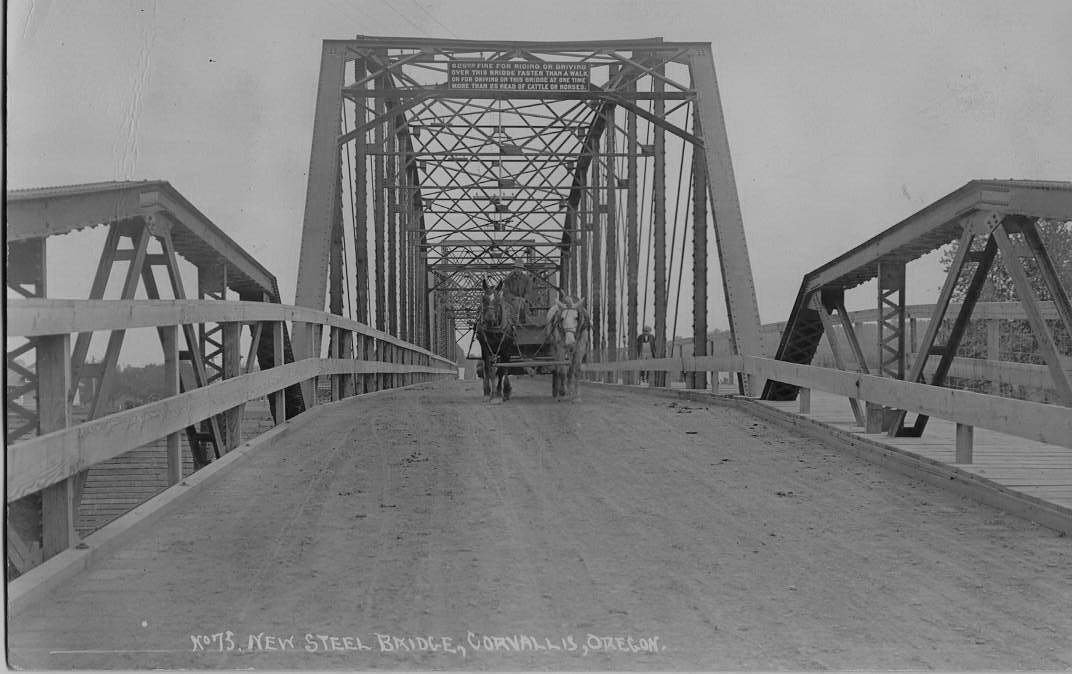
founded. Avery's ferry and later a bridge over the Marys River
eliminated fords in the Philomath vicinity. Philomath is a classic
example of one way towns got started in the Willamette
Valley. In 1865, members of the United Brethren Church living
west of Corvallis decided that they should have a college. They
named it Philomath from the Greek roots meaning a love of learning.
They bought a half section of land. Eight acres of it were reserved
for the campus; the rest was divided into city lots and acreages
to be sold to raise money to build the college.
Proceeds from selling lots and mortgaging
the property made possible the erection of the center section
of the Philomath College building, which opened its doors to
students in October 1867. It served for a time as the local public
school as well as a college. East and west wings were added early
in this century. The college continued as a private liberal arts
college until closed in 1929. The town, which took the name of
the college, has developed as a center for the wood-products
industry. The college building, now on the National Register
of Historic Places, has become the Benton County Historical Museum.
ALONG THE ALTERNATE ROUTE
Wren developed on the Donation Land Claim
of George P. Wrenn at the junction of two roads and the Oregon
Pacific railroad.
Kings Valley was settled by the King family
twelve years after Young's 1834 horse drive. Nahum King from
Massachusetts and his wife Serepta from New York state had had
sixteen children. They had lived in Ohio and Missouri before
coming to Oregon by covered wagon in 1845. Three of their children
died in childhood. Two elder daughters had married and did not
join their parents on the westward trek. The other eleven offspring,
some with families of their own, came west with Nahum and Serepta.
Daughter Sarah died in eastern Oregon leaving a widower and two
small children. Eldest son John and all of his family except
5-year-old Luther drowned coming through the Columbia Gorge.
The rest moved into uninhabited Kings Valley in the spring of
1846 and staked out land claims.
Sarah's widower, Rowland Chambers, soon married
Lovisa, 18, the eldest of the unmarried King daughters. They
eventually had 14 children of their own. Chambers was given a
choice of land claims along the Luckiamute River because he was
building a grist mill. He put it into operation in 1853 and opened
a post office two years later.
One of the King sons, Amos Nahum moved to
Portland, where he operated a tannery along the creek now covered
by the Civic Stadium, developed Kings Heights, and sold 40 acres
of his property for the beginning of Washington Park. The youngest
King son, Solomon, operated a livery stable in Corvallis and
five times was elected sheriff of Benton County.
In 1856, the U. S. Army brought new life to
Kings Valley by establishing Fort Hoskins on its western edge.
The fort closed in 1865. For a time early in this century, Kings
Valley was fairly prosperous with a large sawmill and with the
maintenance shops for the Valley and Siletz Railroad, but now
Publishers Paper Company (owned by the Los Angeles Times) owns
the abandoned mill site and forest lands. The road is being torn
up. A few of the hundreds of King descendents still live in the
valley. The one store is operated by descendents of early pioneer
Larkin Price.
North of Kings Valley a tributary of the Luckiamute
was named Pedee Creek by Cornelius Gilliam, in memory of the
Pedee River in his native North Carolina. Gilliam played a short
but dramatic part in Oregon history. A "robust, impulsive, sympathetic,
willful, courageous leader," he fought Indians in the Black Hawk War and in Florida. As a county sheriff,
he had helped chase the Mormons out of Independence, Missouri.
He and his family and other relatives came west in 1844 under
his leadership. They became the first settlers south of La Creole
Creek. As an ordained minister, he organized and preached to
a Free Will Baptist congregation. He sternly believed that Great
Britain had no right to the Oregon Country. Because of his religious
and patriotic zeal he was sometimes called the Oliver Cromwell
of the frontier. Twice in 1846 he joined explorers trying unsuccessfully
to find a pass over the Cascade Range. After the Whitman Massacre,
he volunteered to
lead Oregon volunteers in the Cayuse War. In eastern Oregon during
the campaign, he accidentally shot himself to death. Gilliam
County is named for him. His widow and several relatives obtained
Donation Land Claims in southwest Polk County, but he died before
the law was passed. A place near Fern Corner is still called
Gilliams.
The main HBC pack trail and the alternate
we have been following joined somewhere near the Little Luckiamute.
The main trail, after fording the Marys River, crossed what is
northwest Corvallis and went north through Lewisburg. The winding
strip of old highway that passes the entrance to Peavy Arboretum
in on the old pack trail. It became the Portland and Umpqua Valley
Wagon Road and eventually U. S. 99W.
Opposite the main entrance to Adair Village,
the old pack trail and wagon road veered off to the northwest.
That bit of road is blocked now, but a half mile north the Sulphur
Springs Road leads back to the pack trail route. Continuing northwestward
it goes through the ghost town of Tampico and in about five miles
reaches Airlie.
Airlie was named for Scottish Earl of Airlie,
head of the company that financed building the narrow-gauge Oregonian
Railway that for nearly fifty years ran from this terminus in
southern Polk County to Dundee (named for Airlie's home town)
in Yamhill County. Stations along the Oregonian included Monmouth,
Dallas, Smithfield, Perrydale, Whiteson, Lafayette, and West
Dayton. Early in this century, Airlie had two trains each day
from Monmouth and connection with two round trip trains daily
from Portland and Corvallis. The town had a post office, two
stores, a blacksmith, barber, grain warehouse, sawmill, and lumber
yard. Southern Pacific acquired the line, tore up the three-foot-wide
tracks, abandoned some sections, rebuilt others to standard gauge,
and continues to use some parts today.
The present county road north from Airlie
crosses the Valley & Siletz Railroad at Tartar, the Luckiamute River at Maple Grove, and the Little
Luckiamute near Fern Corner. A mile north of Fern Corner is Guthrie
School, established in 1886-87. It played an important part in
the social and educational life of this community. Dallas owes
its development in part to the stream called both La Creole and
Rickreall that runs through the town. According to legend the
French-Canadian packers recalled that a native of the country,
a Creole, had drowned at their customary fording place of this
stream and dubbed it La Creole Creek. Early pioneers claimed
that the Indian name for it was Rickreall and that the stream's
name was not merely a corruption of La Creole. The argument goes
on, even today.
The power of this stream was put to use as
early as 1845, when James O'Neal built a grist mill four miles
up stream at a place called Ellendale. James Nesmith (later a
U. S. Senator) operated the mill for a time.
A young bachelor from Tennessee named John
E. Lyle came west in 1845 driving a wagon for Amos Harvey, who
later donated land for Bethel College. Along the way west, according
to legend, Lyle met and fell in love with Ellen, daughter of
Felix and Ellen Scott, but alas, the Scotts decided to go to
California rather than to continue on the Oregon Trail. The lovers
vowed to meet again some day, and their hopes were answered the
following spring when the Scotts, Eugene Skinner, and Elijah
Bristow came north on the pack trail to become the first settlers
in Lane County. While the men were searching for home sites,
the Scott family stayed with settlers on the La Creole and John
and Ellen were reunited. They were married in November 1846 and
eventually had seven children.
Lyle at first taught school at the newly created
Jefferson Institute a mile west of Nathaniel Ford's claim at
present Rickreall. He also became the first Clerk of
Polk County and the Lyles moved upstream to Cynthia Ann, the
county seat. Their home was sometimes used for court before a
court house was built. Cynthia Ann on the north side of La Creole
Creek proved a poor location. Lyle and two others donated land
south of the creek to build La Creole Academy and to sell to
raise money to build the school. Around this nucleus developed
the county seat, which changed its name to Dallas for Polk's
Vice-President George M. Dallas. Lyle was the first postmaster
in Dallas in 1852.
A mill race from the creek powered the first
grist mill in the town, the Machine & Locomotive Works that became nationally known as Towmotor, and the first electric
power generator. A woolen mill operated at Ellendale by Nesmith
burned in 1871. One later came to Dallas. The tannery now on
the National Register of Historic Places got its start in 1863.
The building burned in 1903 but was replaced on the same site
and continues to operate as the unique Muir & McDonald Tannery, making fine leathers by the 19th century methods. Dallas has
had at least one newspaper since 1868, the present one being
the well-known Itemizer-Observer. "Terror Engine No. 1" in 1885
replaced the hand-operated fire engine used previously.
John Lyle died in 1862. Ellen, his widow,
later sold the city their "Old Campground" for $350 to start the present city park. A town hall and opera house built 1887
was torn down in 1912 to make room for the Carnegie Public Library
still in use. The present courthouse of native sandstone dates
from 1900.
The city of Independence with direct rail
connection with Portland and Corvallis after 1880 made a strong
bid to wrest the county seat from isolated Dallas. Frightened
by this threatened take-over, Dallas raised $17,000 to persuade
the Oregonian Railway to run its narrow-gauge line from Airlie
and Monmouth through Dallas and held onto the county seat. Lumberman
Louis Gerlinger built a road from West Salem in 1903 to support
his logging sawmill operations. His Dallas operation eventually
grew to become Willamette Industries, one of the nation's major
wood-products corporations.
In 1900 La Creole Academy united with Lafayette
Seminary to become Dallas College. Rev. C. C. Poling moved to
Lafayette to become the first president. His son, Daniel A. Poling,
class of 1905, became the College's most famous graduate as international
head of Christian Endeavor and editor of the Christian Herald,
and author of many books. The college closed in 1915.
By 1901 the city had developed to such an
extent that an ordinance was passed banning livestock from running
at large. In 1906 the speed limit within the city was established
at 6 mph. Hard surface paving was laid on parts of three streets
in 1913.
The home of John and Ellen Lyle built in 1858
on the corner of Ellendale and Levens streets remained standing
until 1949, when it made way for construction of the John E.
Lyle Elementary School.
Along Salt Creek, the next little valley north
of the La Creole, the Applegate brothers, Charles, Lindsay, and
Jesse and their families first made their homes after coming
to Oregon by covered wagon in 1843. After Lindsay and Jesse had
scouted out what became known as the Applegate Trail in 1846
all three brothers decided to move to Yoncalla.
At Perrydale the old railway depot is still
standing. Near where the drovers crossed Ash Swale, a settlement
called Amity got its start in 1847-48. Two rival factions vying
for the location of a school came to an amicable agreement and
called the log structure Amity School. The Watt brothers had
a part in this. Joseph went back to Missouri and persuaded brother
Ahio to help him herd 330 sheep to Oregon in 1848. Ahio planned
to join the gold rush to California but instead decided to stay
and become the first teacher of Amity School. Joseph brought
not only sheep in 1848 but also machinery for spinning wool.
He helped organize the first woolen mill on the west coast on
Mill Creek in Salem and shipped the first wool from Oregon to
a foreign port in 1868.
Members of the Disciples of Christ (Christian)
church formed a congregation in Amity in 1853. Today it is said
to be the oldest congregation of that denomination in the far
west. At Bethel, now a ghost town a few miles to the southeast,
this denomination also started Bethel College, which in a few
years consolidated with Monmouth University to form
Christian College, the forerunner of Western Oregon College at
Monmouth.
Around the ford of the Yamhill River on the
pack trail arose a community that Joel Perkins laid out as the
town of Lafayette in 1847. It became the principal outfitting
center for would-be miners leaving for California and the main
commercial town for western Oregon. The Provisional Legislature
named it the seat of government for the Yam Hill District, one
of the four original administrative units of the Oregon Country.
Its jurisdiction ran west to the Pacific Ocean and south to Mexican
California and early trials and debates were held in this "Athens of Oregon."
Ben Holladay's railroad in 1872 bypassed Lafayette.
Nearby McMinnville was linked with the railroad a few years later
and prospered. McMinnville took the county seat away from Lafayette
in 1889. Lafayette Academy was opened in the old county buildings
the next year, but after a decade it was moved to Dallas to be
consolidated with La Creole Academy to form Dallas College. Lafayette
languished and has failed to live up to its promising start.
The pleasant valley along Chehalem Creek eight
miles north of Lafayette has mementoes of Ewing Young:
- The Ewing Young School
- A round-topped
oak tree that is said to have grown from an acorn planted on
his grave.
- A marker on Highway 240 indicates location of farm
and grave.
- A park is being developed on lower Chehalem Creek,
south of Newberg, where Young started his still and built his
mills.
Quakers settled Newberg in the 1880s. One of them, Dr.
John Minthorn had been a teacher at the Forest Grove Indian
School,
but after
the buildings burned twice the Indian Service moved the school
to Chemawa north of Salem. Minthorn moved to Newberg and helped
start the academy that has become George Fox College. His sister
Huldah and her husband, Jesse Hoover, the blacksmith in West
Branch, Iowa, both died leaving a nine-year-old son. Relatives
shipped young Herbert off to his uncle John in Oregon. Being
an orphan passed around among relatives seems to have had a
lasting effect on Herbert Hoover. In his later years he took
many opportunities
as head of the American Relief Administration after World War
I, as Secretary of Commerce, and as President
of the United States to relieve anxiety and suffering among
children. "Bertie" Hoover's
swimming pool was near where Ewing Young built his mills.
THE LEGACY OF EWING YOUNG
TWENTY-FIVE years before the famous cattle
drives in Texas and on the Great Plains, Ewing Young showed the
feasibility of driving large herds of cattle over hundreds of
miles of plains, swamps, mountains, and forests. Others followed
his example. Four years after Young's cattle drive, Solomon H.
Smith, who had worked for Young, and Rev. J. H. Frost successfully
herded fifty head of cattle from Salem over the Coast Range and
along the untracked coast to the Clatsop Plains. In 1842, Calvin
Tibbetts, who had been on Young's cattle drive, took a herd over
the Smith/Frost trail to Clatsop Plains. In 1843, as recounted
in Jesse Applegate's A Day with the Cow Column, covered wagon
immigrants began bringing large herds on their way west.
By bringing first the horse herd and then
the cattle herd, Young added immeasurably to the prosperity of
the settlers. He knew enough of practical animal husbandry to
demonstrate that well tended herds increase rapidly. In less
than a decade he became the most prosperous rancher in the Willamette
Valley.
He imported not only livestock but also men
who helped develop the territory. Hauxhurst took up a land claim
on Mill Creek in Salem; in the freight business he brought the
first circus to Salem; he later pioneered at Bay Ocean on the
Oregon Coast. Gale became a shipbuilder, cattle driver, and member
of the first Executive Committee for the Provisional Government.
Hauxhurst, Gale, Howard, McCarty, and John Edmunds voted in favor
of forming a Provisional Government at the famous Champoeg meeting
in May
1843.
The clamor that arose over Young and Carmichael's
threat to build a whiskey distillery and their eventual acquiescence
to the will of the public was the beginning of Oregon's long
history of public support of liquor control.
Young's death and the settlement of his estate
brought about a unique chain of events leading to the establishment
of a self-imposed government to handle civil and criminal problems
in the tradition of Anglo-American law and order. This citizen
involvement in self-government led to what has been called the
Oregon System: the Initiative, Referendum, Recall, humane labor
laws, secret ballot, woman suffrage, and environmental concerns.
Young demonstrated for those who came later
that courage, resourcefulness, energy, and enterprise were elements
in building a prosperous commonwealth in a far western wilderness.
He also illustrated that one cannot take acid for indigestion
and expect to live to a ripe old age.
RELATED READINGS
Kenneth L. Holmes, Ewing Young: Master Trapper. Portland: Binfords & Mort,
1967.
"John Work's Journey from Fort
Vancouver to Umpqua River, and Return, in 1834." Introduction and comments by Leslie M. Scott. Oregon
Historical
Quarterly XXIV, Sept. 1923, pp. 238-268.
Devere Helfrich and Helen Helfrich, Applegate
Trail West of the Cascades. Klamath
Falls: Klamath County Historical Society (n. d.)
William A. Slacum, Memorial to the Congress
of the United States, December 18,
1837. Reprinted Fairfield, Washington: Ye Galleon Press, 1972.
John E. Smith, The Applegate Trail in Benton
County and Early State Colleges of
Oregon. Published by the author, 1941.
Kenneth Munford, The Old Oregon-California
Pack Trail. Tour Guide Series.
Corvallis: Horner Museum, Oregon State University, 1979.
Caroline C. Dobbs, Men of Champoeg. Portland:
Metropolitan Press, 1932.
pp. 9, 17, 23, 24, 25, 185.
Charlotte L. Wirfs, "Dayton,
Sheridan and Grand Ronde Railroad Company." In
Historically Speaking IV, Polk County Historical Society, 1980.
Ruth Stoller, ed., Old Yamhill. Lafayette:
Yamhill County Historical Society, 1976.
Oregon Historical Landmarks: Willamette Valley.
Oregon Society, Daughters of
the American Revolution, 1963, pp. 12, 26, 28, 32, 44.
|